Given head, the head of a linked list, determine if the linked list has a cycle in it.
There is a cycle in a linked list if there is some node in the list that can be reached again by continuously following the next pointer. Internally, pos is used to denote the index of the node that tail's next pointer is connected to. Note that pos is not passed as a parameter.
Return true if there is a cycle in the linked list. Otherwise, return false.
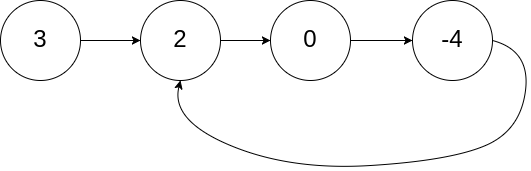
Example 1:
Input: head = [3,2,0,-4], pos = 1
Output: true
Explanation: There is a cycle in the linked list, where the tail connects to the 1st node (0-indexed).
Example 2:
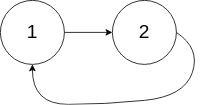
Input: head = [1,2], pos = 0
Output: true
Explanation: There is a cycle in the linked list, where the tail connects to the 0th node.
Example 3:
Input: head = [1], pos = -1
Output: false
Explanation: There is no cycle in the linked list.

Constraints:
- The number of the nodes in the list is in the range [0, 104].
- -105 <= Node.val <= 105
- pos is -1 or a valid index in the linked-list.
My Solution
We can solve this in two ways. One way is to store all the nodes in a HashSet as we visit them. If we ever see the same node again, we know that it has a cycle so we can return. If there is no cycle we end up storing all the nodes in the HashSet and reach the end of the list. Time Complexity for this algorithm would be O(n) and space complexity would also be O(n). We can improve on this. We can initialize two pointers starting at different locations of the list. We keep advancing the two pointers forward at different rates until one of the pointers reaches null, or in other words the list does not have a cycle, or we reach the same node, in which case there is a cycle.
Time complexity for this algorithm would also be O(n), but space complexity would be O(1) since we only require constant extra space.
/**
 * Definition for singly-linked list.
 * class ListNode {
 *     int val;
 *     ListNode next;
 *     ListNode(int x) {
 *         val = x;
 *         next = null;
 *     }
 * }
 */
public class Solution {
    public boolean hasCycle(ListNode head) {
        if (head == null) {
            return false;
        }

        ListNode n1 = head;
        ListNode n2 = head.next;

        while (n1 != null && n2 != null) {
            if (n1 == n2) {
                return true;
            }

            n1 = n1.next;
            n2 = n2.next;

            if (n2 != null) {
                n2 = n2.next;
            }
        }

        return false;
    }
}