Given the root of a binary tree and an integer targetSum, return true if the tree has a root-to-leaf path such that adding up all the values along the path equals targetSum.
A leaf is a node with no children.
Example 1:
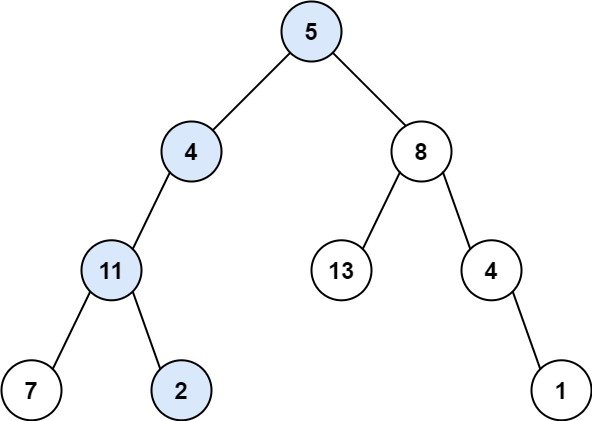
Input: root = [5,4,8,11,null,13,4,7,2,null,null,null,1], targetSum = 22
Output: true
Explanation: The root-to-leaf path with the target sum is shown.
Example 2:
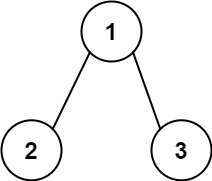
Input: root = [1,2,3], targetSum = 5
Output: false
Explanation: There are two root-to-leaf paths in the tree:
(1 --> 2): The sum is 3.
(1 --> 3): The sum is 4.
There is no root-to-leaf path with sum = 5.
Example 3:
Input: root = [], targetSum = 0
Output: false
Explanation: Since the tree is empty, there are no root-to-leaf paths.
Constraints:
The number of nodes in the tree is in the range [0, 5000].
-1000 <= Node.val <= 1000
-1000 <= targetSum <= 1000
My Solution
We can solve this with depth first search. First off, if root is null, we just return false. If root is a leaf node and the targetSum is equal to the value at root, we return true. Otherwise we just recurse on the left and right subtrees and check whether there is a path on the left and right tree. We also subtract the root’s value from the targetSum to include the current root’s value in the sum.
Time complexity is O(n) in the worst case since we visit all the nodes. Space complexity is O(1) since we only use constant extra space.
/**
 * Definition for a binary tree node.
 * public class TreeNode {
 *     int val;
 *     TreeNode left;
 *     TreeNode right;
 *     TreeNode() {}
 *     TreeNode(int val) { this.val = val; }
 *     TreeNode(int val, TreeNode left, TreeNode right) {
 *         this.val = val;
 *         this.left = left;
 *         this.right = right;
 *     }
 * }
 */
class Solution {
    public boolean hasPathSum(TreeNode root, int targetSum) {
        if (root == null) {
            return false;
        }

        if (root.left == null && root.right == null && root.val == targetSum) {
            return true;
        }

        if (root.left != null && hasPathSum(root.left, targetSum-root.val)) {
            return true;
        }

        if (root.right != null && hasPathSum(root.right, targetSum-root.val)) {
            return true;
        }

        return false;
    }
}